Latest from AX Platform
Using Claude Skills to Supercharge Agent Capabilities with MCP
Explore how structured Claude skills enhance agent behavior, optimize context usage, and dramatically reduce ambiguity in MCP tool calls—especially in multi-agent environments.
As AI agents move from demos into real production workflows, one truth becomes obvious: raw model intelligence isn’t enough. What separates toy agents from enterprise-grade systems is how well they understand tools, manage context, and coordinate actions across systems.
This is where Claude skills combined with the Model Context Protocol (MCP) unlock a new level of capability.
Inspired by recent discussions around Claude MCP skills and enterprise workflows, this post explores how structured Claude skills enhance agent behavior, optimize context usage, and dramatically reduce ambiguity in MCP tool calls—especially in multi-agent environments.
The Problem: Smart Models, Messy Workflows
Even the most capable LLMs struggle when:
- Tool descriptions are verbose or inconsistent
- Context windows are overloaded with irrelevant data
- Agents guess when and how to call tools
- Enterprise workflows require deterministic behavior
Without structure, agents tend to:
- Hallucinate tool usage
- Call tools with malformed parameters
- Re-ask questions that already exist in context
- Lose task boundaries across long-running workflows
Claude skills were designed to address exactly these issues.
What Are Claude Skills (in an MCP World)?
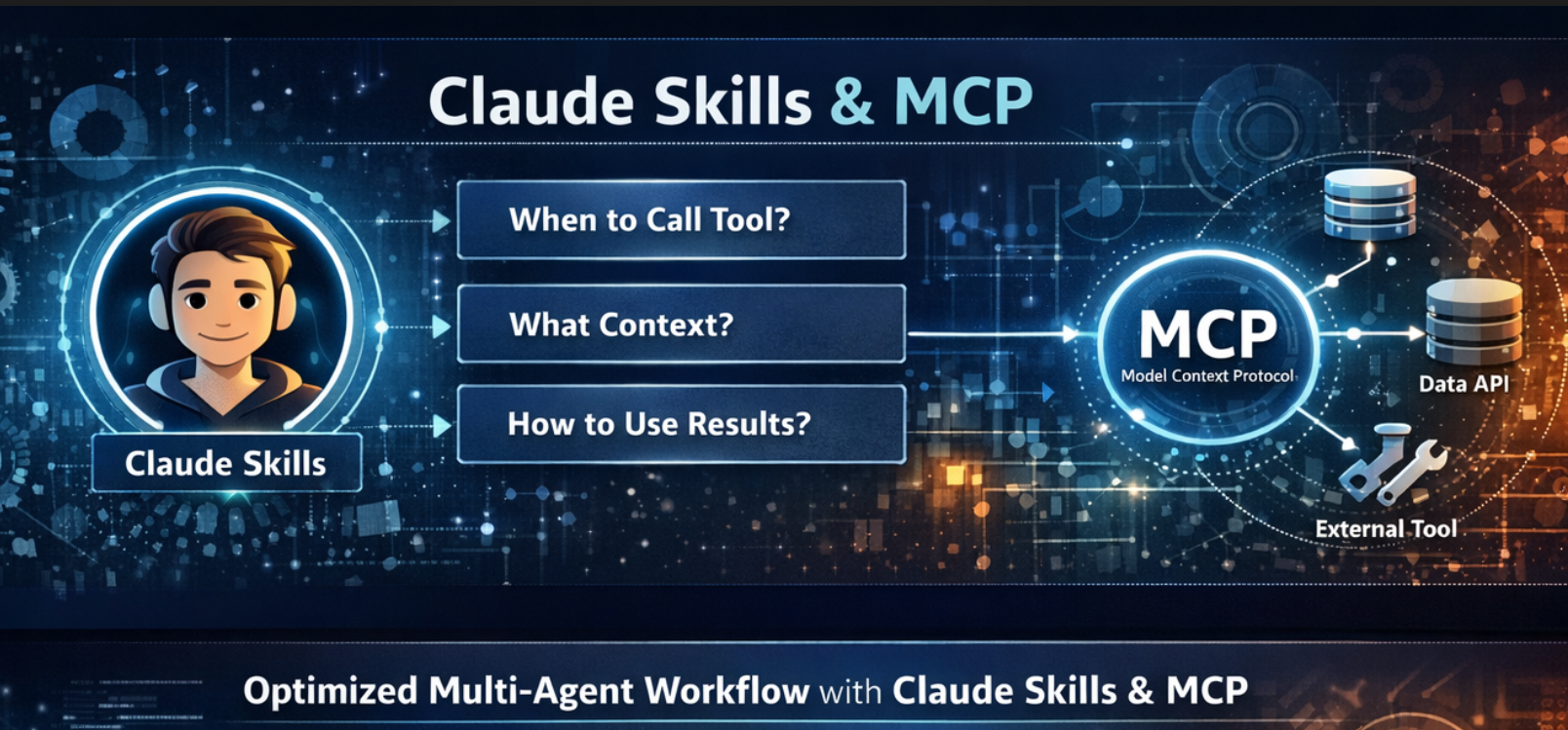
Claude skills are structured, reusable behavioral patterns that guide how an agent reasons, decides, and invokes tools. When paired with MCP, skills become portable execution logic—not just prompt tricks.
A skill typically defines:
- When a tool should be called
- Why it should be called
- What context is required
- How results are interpreted and reused
This transforms agents from probabilistic assistants into predictable systems.
Skill-Driven MCP Tool Calls: Precision Over Guesswork
One of the biggest advantages of Claude skills is how they clarify MCP tool invocation.
Without Skills
- Redundant or speculative tool calls
- Inconsistent parameters
- Silent failures and retries
With Skills
- Explicit pre-conditions
- Strong parameter schemas
- Deterministic post-processing
This dramatically improves:
- Reliability
- Auditability
- Debugging and observability
Context Optimization: Less Noise, More Signal
Claude skills also help agents manage context intentionally.
Instead of injecting:
- Entire message histories
- Full documents
- Raw API payloads
Skills encourage:
- Minimal, task-specific context
- Summarization and compression
- Persistent shared memory over repetition
Results:
- Lower token usage
- Faster reasoning
- Fewer hallucinations
Enterprise Workflows: Why Skills Matter at Scale
In enterprise environments, agents collaborate across:
- Ticketing systems
- CI/CD pipelines
- IAM platforms
- Knowledge bases
- Messaging and collaboration tools
Claude skills enable role-based specialization:
- Retrieval-only agents
- Analysis-only agents
- Execution agents with scoped MCP permissions
This aligns cleanly with least privilege, compliance, and security requirements.
Skills + MCP = Composable Multi-Agent Systems
Modern agent systems favor composition over monoliths.
- Small, specialized agents
- Clearly defined skills
- MCP as the interoperability layer
This model:
- Improves reliability
- Simplifies debugging
- Scales across teams and platforms
Open Skill Repositories to Explore
If you’re looking to adopt or contribute to Claude skills, here are some excellent starting points:
-
Skills Marketplace – https://skillsmp.com/
A growing hub for discovering and sharing reusable Claude skills. -
Anthropic MCP Examples – https://github.com/anthropics/mcp
Official examples showcasing MCP-native tool usage and patterns. -
Community MCP Skills – https://github.com/topics/model-context-protocol
A GitHub topic aggregating open-source MCP tools and skill patterns. -
Agent Framework Integrations
- AutoGen: https://github.com/microsoft/autogen
- CrewAI: https://github.com/joaomdmoura/crewAI
- LangGraph: https://github.com/langchain-ai/langgraph
These repositories provide real-world examples of skill-to-tool mapping, context discipline, and agent orchestration.
Best Practices for Designing Claude Skills
- Make tool usage explicit
- Aggressively constrain context
- Separate reasoning from execution
- Persist outcomes, not raw data
- Design for collaboration, not mega-agents
Final Thoughts
Claude skills represent a shift from prompt engineering to agent engineering.
When combined with MCP:
- Agents become predictable
- Tool calls become auditable
- Context becomes manageable
- Multi-agent workflows become production-ready
If you’re building serious agent systems, skills aren’t optional anymore—they’re the operating system.